

At the 2026 edition of Salone del Mobile.Milano 2026, Italian upholstery brand Egoitaliano unveiled 'This is not a collection', a concept-driven project positioned less as a traditional product launch and more as a broader statement about identity, comfort and contemporary living.
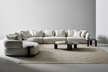
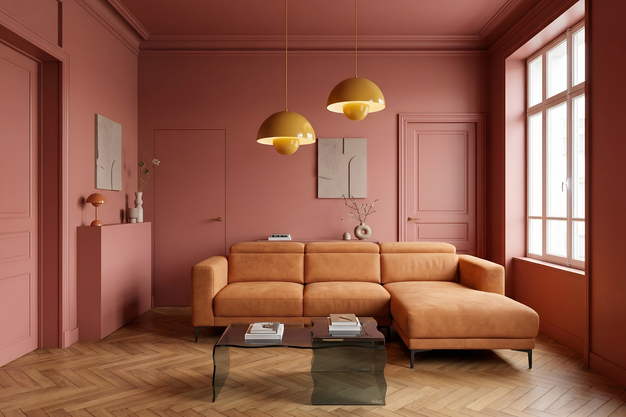 © EgoitalianoByron Suede.
The installation explored the relationship between colour, materiality and function through a range of sofas and armchairs designed to express what the company described as an "ever-evolving language".
Colour and materiality at the centre of the concept
Rather than focusing solely on individual products, the presentation emphasised a cohesive visual system built around saturated tones, dusty neutrals, deep greens and vibrant pinks.
According to Egoitaliano, colour functioned as a storytelling tool, shaping emotional atmosphere and reinforcing the brand's identity across multiple seating collections.
Materials also played a defining role throughout the stand, with velvet finishes, textured fabrics, leather upholstery and sculptural forms contributing to a softer and more tactile interpretation of contemporary comfort.
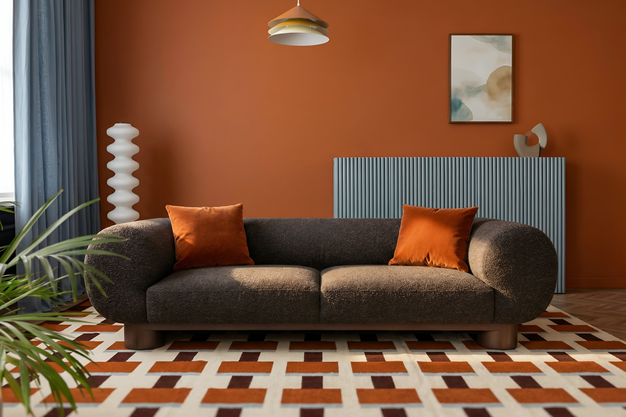 © EgoitalianoAster.
Sculptural seating and adaptive comfort
Among the new introductions was MOROSA, designed by Giulio Manzoni, a seating system characterised by continuous rounded volumes and bi-elastic upholstery designed to intensify softness and tactile perception.
The sofa incorporated microfloc padding manufactured from recycled PET, intended to replicate the comfort of goose down while reinforcing the company's sustainability ambitions.
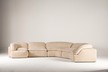
BYRON explored a more restrained aesthetic language, combining clean lines and elevated proportions with manually sliding seats and adjustable backrests that extended seating depth by an additional 37 cm.
Meanwhile, BREZZA introduced softer, rounded forms and velvety upholstery designed to create a more informal and approachable interpretation of contemporary comfort.
Existing systems evolved through modularity
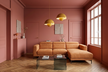
The company also expanded its previously launched EROS system with the introduction of a dormeuse configuration. The updated corner composition allowed for more fluid spatial layouts while reinforcing the modular adaptability increasingly associated with contemporary living environments.
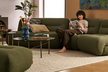
ASTER drew inspiration from 1970s design language through cylindrical armrests and sculptural proportions, while maintaining a more contemporary material and colour palette.
Additional introductions included the HUG armchair, also by Giulio Manzoni, developed using moulded foam technology to create a continuous wrapped form, and OASI, a sofa bed designed to combine soft, rounded aesthetics with integrated functionality.
Formal experimentation through geometry
The NEBULA armchair, designed by Filippo Di Lecce, introduced a more architectural design language through a faceted shell and hexagonal footprint. Contrasting piping highlighted the relationship between the structured exterior and softer internal seating surfaces.
Across the stand, the collections reflected a growing industry focus on adaptable comfort, sculptural forms and emotionally driven interiors, where upholstery design increasingly functions as both spatial architecture and personal expression.
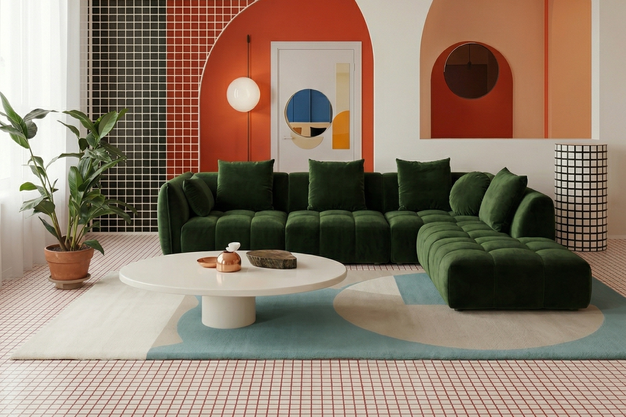 © EgoitalianoEros.
Design as an evolving language
Founded in Matera in 2007, Egoitaliano continues to position itself at the intersection of contemporary design, pop culture and Italian upholstery manufacturing.
With more than 140 retail locations in Italy and distribution across Europe, North America and Asia, the company described THIS IS NOT A COLLECTION as an ongoing direction rather than a finished product narrative.
According to the brand, the project represented "a way of understanding design as an expression of identity, relationships and contemporaneity".
More information:
Egoitaliano
www.egoitaliano.com