

At a key industry gathering in Cologne, experts and leading representatives from across the furniture sector explored how the forthcoming Digital Product Passport (DPP) could offer the industry far more than regulatory compliance, positioning it instead as a catalyst for innovation, transparency, and sustainability.
 © Moebelindustrie | VHK
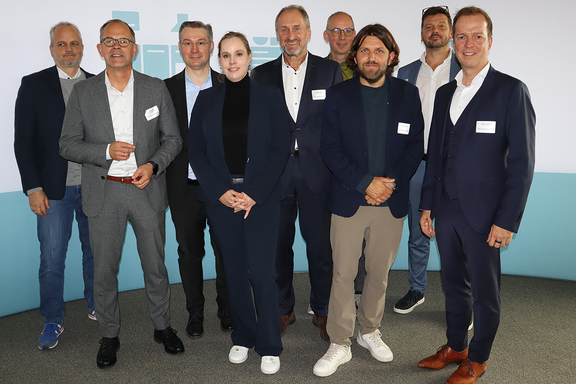
They presented and discussed the digital product passport (from left to right): Alexander Rhetz (Otto), Jan Kurth (VDM/VHK), Christoph Attila Kun (BASF), Nina Stock (BMWE), Dirk Krupka (Häcker Küchen), Olaf Plümer (DCC), Alexander König (GS1 Germany), Patrick Sönke (Integrated Worlds), and Thomas Rödding (Narravero).
Under the banner "A Change in Perspective on the Digital Product Passport – More Opportunity than Regulation for the Furniture Industry", the event, hosted by the Associations of the German Furniture Industry (VDM/VHK), highlighted the DPP's potential benefits along the entire value chain.
The DPP, to be introduced under the EU's Ecodesign for Sustainable Products Regulation (ESPR), will from 2030 provide detailed information for each piece of furniture, including its materials, components, repairability, spare parts, and end-of-life options.
"We would like to help ensure that the furniture industry sees the Digital Product Passport not only as a regulatory obligation but above all as a strategic tool for sustainable corporate development," said Jan Kurth, Managing Director of the VDM, and Olaf Plümer, Managing Director of the Data Competence Center (DCC), welcoming around 80 participants at the Koelnmesse high-rise.
Nina Stock, Senior Government Counsellor at the Federal Ministry for Economic Affairs and Energy, underscored the DPP's potential as "a key to greater transparency, efficiency and sustainable business models," adding: "The digital product passport will come. Those who use it wisely today will not only save costs tomorrow, but will also gain markets, customers and trust."
Providing a European perspective, Franziska Zibold from the European Commission's Directorate-General for the Internal Market explained that implementation would begin in 2027, initially with batteries, before extending to other sectors such as furniture.
Speakers including Christoph Attila Kun (BASF), Thomas Rödding and Dirk Schroeder (Narravero), and Alexander König (GS1 Germany) illustrated how the DPP could streamline data flows, strengthen marketing, and enhance service offerings. From a retail standpoint, Alexander Rhetz (Otto) emphasised that "isolated solutions will not be enough," urging cross-sector integration.
The consortium Furniture-X, represented by Patrick Sönke (Integrated Worlds) and Peter Jürgens (Polipol-Holding), presented collaborative strategies to advance circular business models and improve communication between manufacturers and retailers. "Thinking bigger is now possible," said Jürgens.
Participants called for greater regulatory clarity to prepare effectively for implementation. "We as furniture associations have the important task of helping to shape both the content and the practical implementation of the digital product passport for furniture," concluded Kurth.
More information:
Moebelindustrie | VHK
www.moebelindustrie.de | www.vhk-herford.de