

The acquisition of Kwantum and Leen Bakker by investor Orlando Capital V, reported by InteriorDaily yesterday, marks a crucial tipping point for the Dutch home furnishings retailer. While calm appears to be returning to the organisation, experts caution that a new owner alone will not suffice. According to retail strategists and market analysts, a radical change of direction is needed to rescue the "residential giant" from the grey middle of the market.  © Leen Bakker
The sale by parent company Homefashion Group (HFG) comes after a tumultuous 2025, which saw significant losses. Although the new owner promises stability, the industry remains critical of the path to recovery.
Albert Top, owner of NRG (including Crossmarks and SVT), argues that the chains are victims not only of a challenging market but primarily of "half-hearted choices." Kwantum and Leen Bakker both position themselves as affordable, yet, according to Top, they sit squarely between the price-focused retailers (such as Action and Jysk) and the inspirational specialist stores.
"For Kwantum and Leen Bakker, the 'North Star' has remained too generic," Top explains. He advocates a clear differentiation: Kwantum as the specialist in flooring and window decoration for a younger audience, and Leen Bakker as the affordable full-range retailer with a focus on furniture and bedding for families. "At present, the stores are still too often 'boxes of everything,' positioned somewhere between IKEA and pure specialists."
Format mix
Although dozens of stores have already closed, merely reducing the footprint is a dead end, according to experts. Top emphasizes that a smaller footprint only works if it is strategically filled with a thoughtful mix of formats, including flagship stores, local hubs, and compact outlets.
In addition, the digital backbone needs strengthening. "As long as digital is treated mainly as an additional channel rather than the core of the format, it will remain a 'me too' proposition," says the strategist. Real gains, he adds, come from data-driven sourcing, AR visualization, and a seamless omnichannel experience.
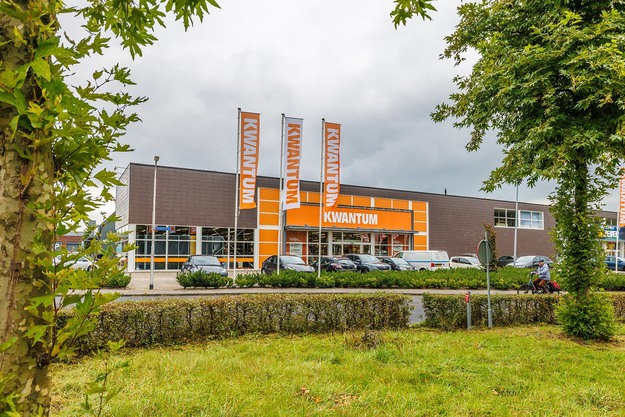 © Kwantum
Opportunities for the 'Local Hero'
Tim Vermeeren of Luxaflex Netherlands sees the shifts in the retail landscape as creating opportunities for smaller players. As large chains such as Kwantum and the recently toppled Carpetland lose ground or change course, there is room for the craftsman.
"The home furnishing sector is shifting from independent professionals with personal style to streamlined formulas," Vermeeren observes. However, he notes a counter-movement: "Smaller players are reinventing themselves, combining online and local approaches, and exploring new forms of customer experience. The smell of carpet and coffee is giving way to clicks, concepts, and communities."
People as carriers of the brand
New shareholder Orlando Capital V faces the challenge of not only stabilizing finances but also transforming company culture. Top concludes that employees on the floor must once again become the carriers of the brand. "Advisory behavior and service must again be immediately recognizable as 'typical Kwantum' or 'typical Leen Bakker.' The red figures are not the end point, they are a hard mirror: those who want to become healthy must dare to make choices."
Hardest hits
The Financieele Dagblad (FD) notes that current market conditions in retail are undeniably tough, with the residential sector taking the hardest hits. A toxic mix of high operating costs, hesitant consumers, and a virtually stagnant housing market is putting many home furnishing concepts under pressure. In this climate, the arrival of an owner with focus, capital, and a long-term vision is crucial for the survival of the Homefashion Group.
Within the portfolio, Kwantum manages to hold its ground relatively well. As the market leader in window and floor products, the chain operates in categories that are less cyclical than large furniture purchases. This strong position, built on a sharp proposition and a clear formula, provides a solid foundation for stability and future growth, according to analysts.
The market for large furniture is facing tougher conditions, making Leen Bakker more vulnerable at a time when consumers are postponing major spending. Nevertheless, this is exactly where the acquisition offers new perspective. With a sharpened strategy and renewed focus under Orlando Capital V, Leen Bakker can reposition itself. The ownership change not only brings much-needed stability but also creates a starting point for recovery in a challenging housing market, the FD concludes.
Sources: Tim Vermeeren, Albert Top, FD