


Developments in the United States furniture market continue to hold significance for the global interiors sector, with recent data pointing to a mixed demand environment shaped by both cyclical and structural factors.
An analysis of key demand indicators highlights four areas shaping the market: online search behaviour, consumer confidence, housing activity and retail sales. Together, these provide insight into both consumer intent and underlying market drivers.
Online search trends indicate a gradual recovery in consumer interest. Following a pandemic-driven surge and subsequent decline during 2022–2023, search activity has been improving since 2024. However, this rebound remains more limited than in Europe, where search levels have recovered more strongly and remain higher overall.
 © Furnilytics
Consumer confidence continues to weigh on demand. Having declined sharply during both the pandemic and the inflation shock of 2022, sentiment in the US has remained relatively weak and volatile. Compared with Europe, US consumer confidence is currently lower, suggesting ongoing caution among households when it comes to discretionary purchases such as furniture.
 © Furnilytics
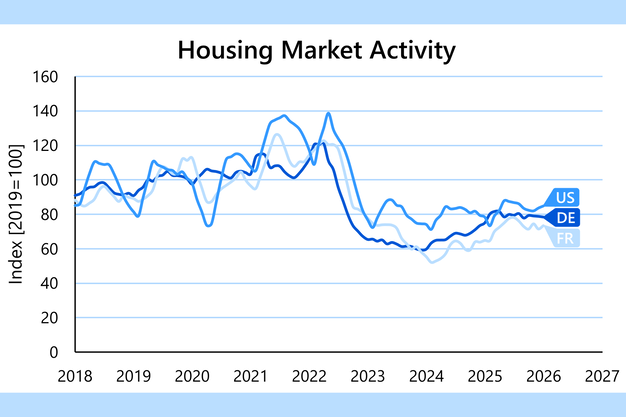
Housing activity, a key structural driver, presents a more supportive signal. After peaking during the pandemic housing boom and declining significantly in 2023, the US housing market has shown signs of stabilisation and modest recovery. While activity levels remain below previous highs, the recovery has been somewhat stronger than in major European markets, indicating potential for gradual improvement in furniture demand linked to housing.
 © Furnilytics
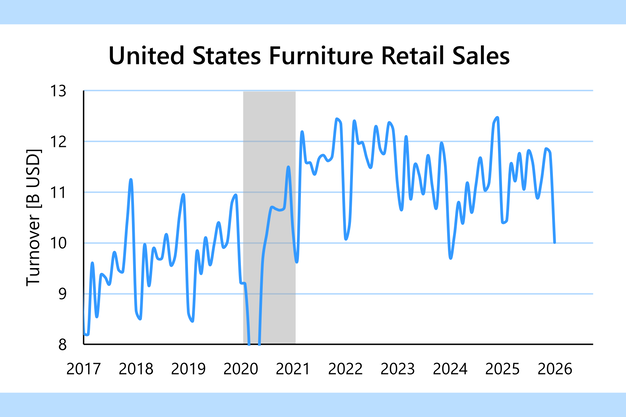
In contrast, retail performance has weakened. Furniture sales, which surged during the pandemic, have become increasingly volatile. Since the second half of 2025, sales have declined noticeably, with a drop of approximately 10.3% year-on-year over the past six months. This contrasts with a more limited decline of around 1% in European markets.
Structural factors may be contributing to this divergence. The US furniture market relies more heavily on imports, which account for around 40% of consumption, compared with approximately 20% in the EU. The downturn in sales coincides with the introduction of new tariff measures in mid-2025, which may have affected pricing and demand more significantly in the US.
 © Furnilytics
Overall, the data suggests the US furniture market remains in a subdued phase. While housing indicators point to gradual improvement, weak consumer sentiment and declining retail sales underline ongoing fragility.
More information:
Furnilytics
www.furnilytics.com