

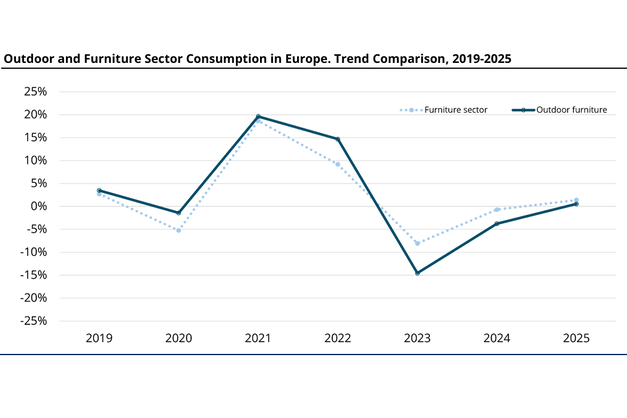
The European outdoor furniture market continues to adapt to shifting consumer behaviour and economic pressures, according to the latest findings from CSIL's The European Market for Outdoor Furniture report (March 2026). Valued at over EUR 3 billion in 2025, the sector remains a significant component of the wider furniture industry, despite a moderation in demand following the surge recorded in 2021 and 2022.
The report notes that the market is increasingly shaped by lifestyle changes, particularly the growing emphasis on outdoor living. Consumers across Europe are investing more in functional and design-led exterior spaces, influencing both product development and purchasing patterns.
 © CSIL
Performance across the region remains uneven, reflecting differences in climate, distribution systems, and consumer preferences. Germany, the United Kingdom, Italy, and France continue to represent the largest markets for outdoor furniture, underlining their importance within the European landscape.
International trade remains a defining feature of the sector. Export and import activity still accounts for a substantial share of production and consumption, highlighting the globalised nature of supply chains. However, 2025 saw a notable decline in exports to the United States, particularly in the metal furniture segment, pointing to shifting trade dynamics.
In terms of distribution, residential and retail channels continue to dominate. At the same time, the contract segment, including hospitality, restaurants, offices, and nautical applications, has shown steady growth in recent years, signalling diversification in demand sources.
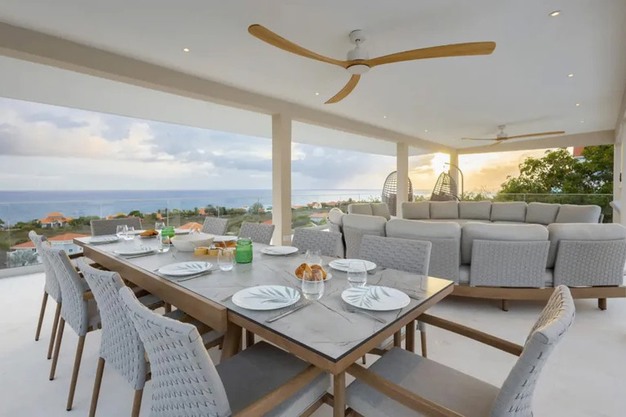 © Couture Jardin COUTURE Jardin's project at Villa Téotlina, Coral Estate, Curaçao
Product development is also evolving. The outdoor furniture category now encompasses a broad and increasingly sophisticated range of collections, comparable to indoor furnishings. Outdoor dining sets remain the largest segment, while upholstered outdoor furniture is expanding at a faster pace than other categories. Emerging segments such as outdoor kitchens and decorative elements further reflect a move towards more functional and lifestyle-oriented outdoor environments.
Looking ahead, the market faces ongoing economic challenges. While the Euro area shows signs of resilience, rising energy costs and subdued consumer confidence are expected to impact discretionary spending. As a result, the European outdoor furniture market is forecast to contract slightly in 2026.
A gradual recovery is anticipated from 2027 onwards, supported by stabilising economic conditions, easing energy prices, and a progressive strengthening of domestic demand.
Source: World Furniture Online