

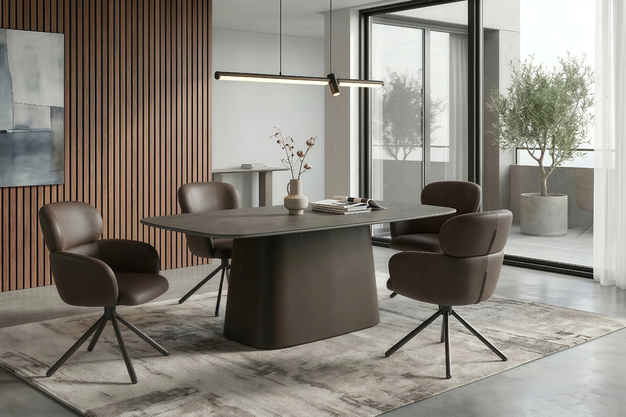
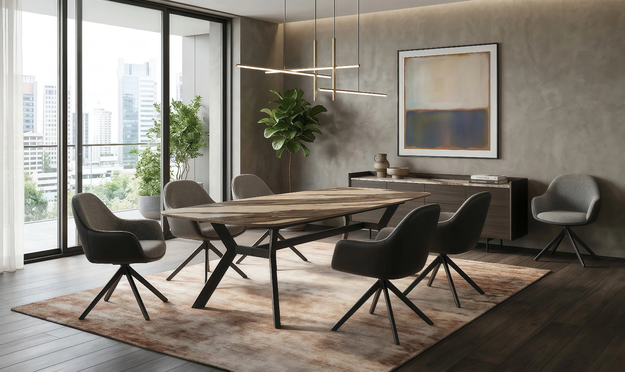
Tigin has positioned itself as a Turkish furniture brand with a clear export focus, merging traditional craftsmanship with contemporary design. Founded to fill a gap in the market, the company operates three production facilities, metal, wood, and upholstery, spanning 20,000 square metres. One of the owners, Hamit Ebeş, recently shared insights with InteriorDaily about the company's design philosophy, production practices, and its approach to navigating the global furniture market.
"Tigin was born out of a desire to bridge the gap between traditional Turkish craftsmanship and the aesthetic demands of the modern global market," Ebeş explains. "Our core mission is to transform living spaces into modern sanctuaries by providing furniture that defines a room through quality and character."
 © Tigin Home
Export-level
Tigin emphasizes what it calls "export-level quality," implemented through a structured quality control system Ebeş describes as the Three-Stage Shield. The first stage focuses on material integrity: "The quality process begins with the raw materials and accessories we use, and their quality is of the utmost importance to us." Precision craftsmanship comes next, supported by CNC machines and robotic systems to ensure consistent assembly. "Each extendable table, for example, is inspected individually on the assembly line after the rails are attached," he adds. The final stage, the "Final Eyes" check, ensures zero structural or cosmetic defects before the product leaves the factory.
This commitment to quality allows Tigin to balance high-volume production with craftsmanship, while serving partners in over 40 countries. The company does not sell domestically, maintaining an export-only business model. "Being able to produce any product in-house makes it easier to monitor all production processes," Ebeş notes, emphasizing that controlling metal, wood, and upholstery production lines is key to maintaining quality at scale.
Logistics and market reach
Ebeş highlights Tigin's strategic advantage in logistics due to its Turkish production base. "In today's volatile global market, the success of a furniture business hinges on two factors: speed and reliability. Türkiye is situated at the centre of the world's most important trade routes, offering a natural logistics hub that connects Europe, Asia and Africa."
This geographic advantage allows shorter production cycles, enabling partners to restock best-sellers in weeks rather than months. The company also offers mixed loading of chairs and tables in a single shipment, reducing landed costs compared to sourcing from multiple suppliers.
Tigin has a diverse customer base, with a strong presence in the Balkans and Eastern Europe, and growing sales in Western European markets such as Germany, France, and Spain. The company plans to expand into African and American markets in the near future. "Our partners and we work constantly to understand market needs, which informs both design and production strategy," says Ebeş.
 © Tigin Home
Geopolitical instability
The global furniture market has shifted significantly since Tigin began exporting. Ebeş points to economic downturns and geopolitical instability affecting consumer spending patterns, particularly in Europe. "People are extending their furniture replacement cycles and turning to cheaper or second-hand products," he notes. Meanwhile, Asian manufacturers are increasing their presence in Europe, sometimes with fully integrated sales and distribution operations, challenging long-established European manufacturers.
The company is also preparing for challenges related to the accelerating trend cycle and rising costs of raw materials and logistics. "Designs become outdated faster than ever before," Ebeş says. "We are shortening our 'design-to-prototype' phase. By keeping manufacturing in-house in Türkiye, we can launch new collections and respond to global trends within weeks, while competitors in Asia may take months." Maintaining raw material inventories and leveraging multiple transport routes also positions Tigin to mitigate disruptions.
'I anticipate more severe fluctuations in the cost of raw materials and logistics due to geopolitical factors or the risk of global or regional conflicts,' Ebeş says.
Modern dining solutions
The company's founders, Isa Candemir and Hamit Ebeş, both come from an industrial design background, which informs their approach to product development and market strategy. Over the next five years, Tigin aims to establish itself as a globally recognized brand in modern dining solutions, setting trends in both design and material use. The company is also investing in research and development to advance sustainable furniture practices, with the goal of expanding its international reach so that its products are available in all key markets.
More information:
Tigin
[email protected]
www.tiginhome.com
Turkey