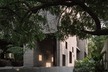


In Ahmedabad, India, architectural studio Studio Saransh has completed MS House, a residential project that reinterprets Brutalist architecture through a deep integration with nature. Designed around nine existing neem trees, the eco-Brutalist home demonstrates how rigid architectural forms can adapt to natural landscapes rather than override them.
 © Ishita Sitwala
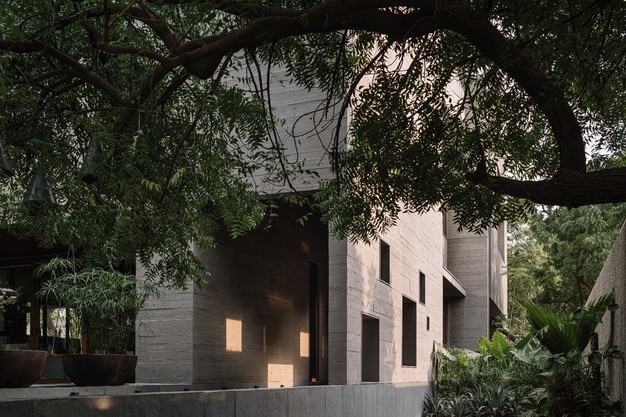
Spanning 6,512 square feet, the residence challenges the traditional perception of Brutalism as an imposing and contextually detached style. Instead, the design allows the site's vegetation to shape the architecture itself. The house's concrete volumes bend and recess to accommodate the trees, while openings and spatial layouts are carefully positioned to preserve their presence within the built environment.
This approach turns the trees into central design elements that influence spatial planning, form and material choices, creating a constant visual and physical connection between the home and its natural surroundings.
Externally, the building's raw Brutalist expression is characterised by deep-set openings and strong geometric forms. However, the material treatment softens this visual impact. Concrete surfaces feature a wood-textured finish that visually connects the structure with the surrounding trees and landscape.
 © Ishita Sitwala
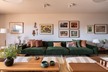
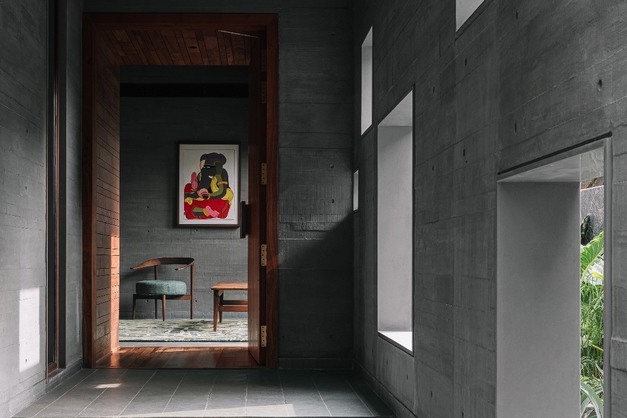
Inside, the architecture transitions into a warmer and more tactile environment. A natural material palette including lime-plastered walls, grey Kota stone flooring and timber accents adds depth and comfort to the interiors. Bespoke furniture pieces and customised details further enhance the domestic character of the space, balancing the architectural strength of the structure with a sense of intimacy.
The design also reflects Ahmedabad's architectural heritage, a city shaped by influential modernist architects such as Le Corbusier and Louis I. Kahn. Rather than replicating these historical references, Studio Saransh reinterprets them through a contemporary lens that responds to current environmental and cultural contexts.
Local craftsmanship played a central role in the project's realisation. The house was constructed entirely on site using regional materials and expertise, including ethically sourced Valsadi teak wood, lime plaster and Kota stone. By involving local artisans, the project not only integrates environmental sensitivity but also celebrates the region's cultural identity and building traditions.
Through its design strategy, MS House proposes a new interpretation of Brutalism, where architecture evolves with its context rather than resisting it. By allowing nature to shape its form, the project offers a model for how robust architectural languages can adapt to ecological and cultural realities.
More information:
Studio Saransh
[email protected]
www.studiosaransh.com