


Italy's furniture industry has long been celebrated for its craftsmanship, design innovation, and global appeal. Beneath the surface of elegance and style lies a stark geographic reality. Italy's furniture production is highly concentrated, with a handful of northern regions carrying the weight of the nation's output while facing the pressures of an uncertain international trade landscape.
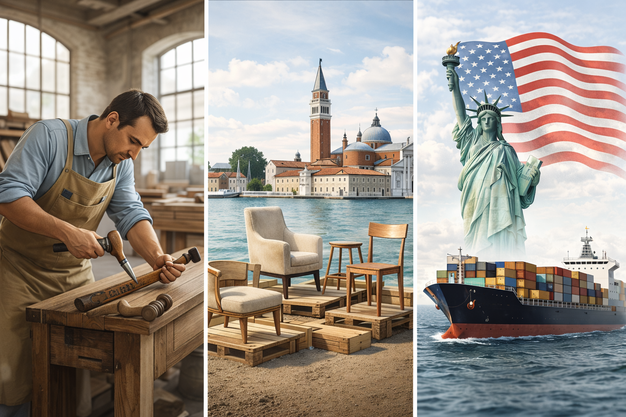 © AI Generated
Northern clusters lead production
Recent data from ISTAT show that Lombardy and Veneto produce nearly half of Italy's furniture, with Friuli-Venezia Giulia and Marche adding another 23.5 percent. In practical terms, four regions generate almost three-quarters of the country's furniture output. This concentration reflects dense industrial networks, long-standing supply chains, and export-oriented ecosystems that have made Northern Italy's furniture districts some of the most competitive in Europe.
Southern and smaller central regions remain niche players. While rich in local tradition and artisanal skills, their production footprint is relatively modest. This uneven geography highlights a dual reality. Italy's furniture strength is formidable, but it is geographically narrow, leaving certain regions more exposed to market fluctuations.
Export intensity varies across regions
Export orientation differs sharply across clusters. Friuli-Venezia Giulia leads the pack with roughly 59 percent of its production sold abroad, followed by Lombardy and Emilia-Romagna at just above 50 percent. Veneto, despite its large production scale, exports about 45 percent, while Marche focuses primarily on the domestic market.
This variation shows that Italy's furniture industry balances international ambition with a robust internal market. Unlike highly export-dependent peers such as Poland, Italian clusters maintain significant domestic demand, providing a natural buffer against global shocks.
US trade brings new challenges
Trade with the United States presents a more complex picture. Germany and France remain steady partners, but post-Covid trends reveal that smaller northern regions, including Friuli-Venezia Giulia, increased their exposure to the US market between 2019 and 2024. Recent developments, including a 13.4 percent effective duty on 63 percent of furniture exports, have caused a 15.5 percent drop in shipments to the US over the past three months.
Regions heavily reliant on the US face tangible risks. Lombardy and Veneto, with more diversified export profiles, show greater resilience. This highlights the importance of balanced international engagement for Italy's furniture hubs.
The path forward
Italy's furniture clusters demonstrate the country's industrial genius with high-quality production, innovation-driven design, and global reach. Yet the very concentration that drives competitiveness also creates vulnerability. Northern regions carry the weight of national output and are most exposed to trade shocks, while smaller regions risk falling further behind if global demand shifts suddenly.
The Italian furniture industry must continue to balance the appeal of export markets with strategic diversification, leveraging domestic demand while carefully navigating trade tensions abroad. The story of Italy's furniture sector reflects both concentrated strength and the need for resilience.
More information and figures:
Furnilytics
www.furnilytics.com