

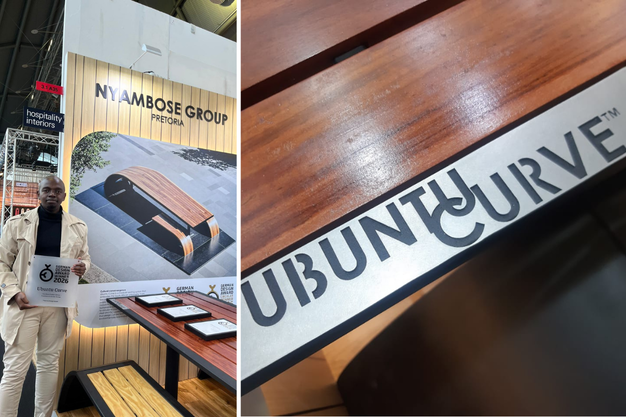
Across today's public and commercial environments, there is a growing demand for furniture and spatial solutions that do more than occupy space. Designers and planners are seeking interventions that foster interaction, support diverse users, and minimise environmental impact, all while remaining adaptable to rapidly changing urban needs. This shift has opened the door for practices that operate at the intersection of architecture, product design, and social innovation, creating objects that function as small pieces of infrastructure rather than standalone furnishings. At the centre of this approach is the studio founded by South African architect Mangaliso Mtetwa, known as Nyambose Group, whose signature product, the patented Ubuntu Curve, recently won the German Design Award 2026 in two categories: Excellent Product Design – Furniture, and Excellent Product Design – Circular Design.
 © Nyambose Group
Pheladi Tlhatlha,associate (left), and Mangaliso Mtetwa, founder of Nyambose Group
From childhood sketches to sustainable architecture
Mangaliso Mtetwa describes architecture not as a career choice, but as a lifelong calling. 'I have been drawing since I was a child. By the time I was 13, I knew I was going to become an architect,' he explains. That early clarity led him to pursue formal training, culminating in a master's degree focused on sustainability and environmental potential at the University of Pretoria, Boukunde (Department of Architecture), where he completed his Master of Architecture.
His professional path has been deliberately broad, spanning government, corporate, and humanitarian work. This diversity, he says, built a comprehensive understanding of how built environments influence society. 'I wanted to understand all the different processes, from policy to community impact. It helps you design with purpose.'
At Nyambose Group, innovation forms the studio's core philosophy. The practice operates as a collaborative platform, working with surveyors, landscape specialists, construction teams, and emerging professionals. 'We collaborate because everyone brings a different perspective. When you combine those perspectives, the value of the project increases,' he notes.
 © Nyambose Group
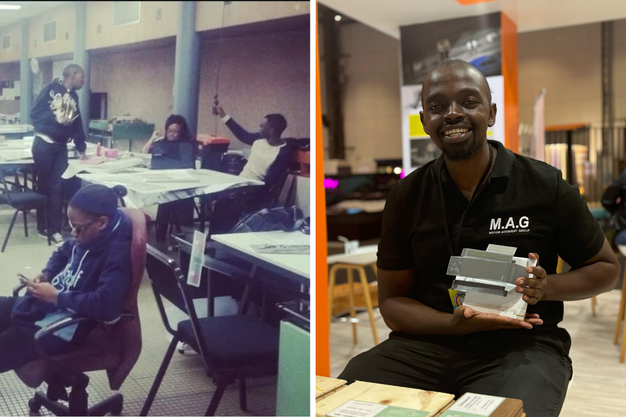
From architecture school boukunde 2014 on the left, to the debut of the small Ubuntu Curve patented product, 3D-printed prototype
The Ubuntu Curve emerged from two years of research into human movement, behaviour, and public interaction. Rather than beginning with aesthetics, Mangaliso focused on how people gather and communicate in shared spaces.
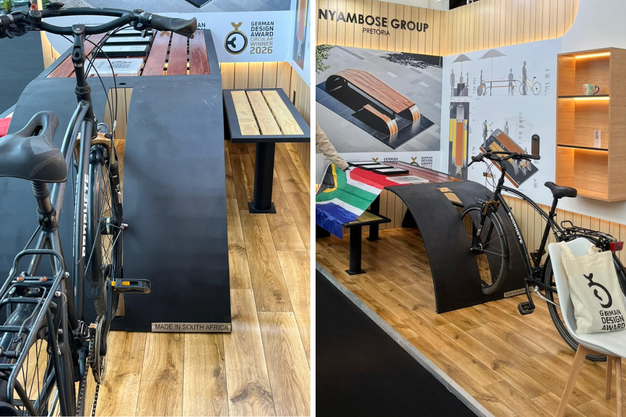
'I studied how people move, how conversations form, and how design can bring people together,' he says. The resulting curved configuration encourages face to face interaction while remaining flexible enough for different group sizes. 'You can configure it for four people or six people, depending on the situation.'
Inclusivity was embedded from the outset. The design accommodates cyclists through integrated bike parking and considers users with visual impairments through contrasting surfaces that help differentiate planes. Lighting is equally purposeful. 'The LED lighting is not decoration. It accentuates the form and makes the furniture usable at night.'
 © Nyambose Group
Culture meets circular design
Beyond functionality, the project reflects the South African philosophy of Ubuntu, emphasising collective wellbeing. This cultural grounding aligns closely with Mangaliso's commitment to sustainable practice.
Materials are locally sourced where possible, combining FSC certified timber with recycled steel to reduce environmental impact. 'We wanted a product that is environmentally friendly but also economically meaningful. When you source locally, you support jobs and reduce carbon footprint.'
The emphasis on circular economy principles extends beyond materials. Mangaliso sees products like the Ubuntu Curve as part of a broader shift in how interiors are conceived and manufactured. 'When you think about circular design, you also think about job creation and long term value for communities.'
 © Nyambose Group
Scaling impact across markets
Looking ahead, the studio is exploring international partnerships, licensing agreements, and custom production to bring the design to wider audiences. Interest ranges from wholesale orders to bespoke colour variations tailored to specific projects.
'We are open to working with manufacturers in different markets. The goal is to scale sustainably, not just to sell products but to create systems that add value,' he explains.
Future work will continue to prioritise human centred solutions, sustainable materials, and emerging technologies such as AI assisted design. 'We cannot keep filling landfills. The future must be circular, inclusive, and beneficial to society.'
For Mangaliso, architecture and product design remain tools for social progress rather than purely commercial output. As he reflects on the journey from childhood sketches to internationally recognised innovation, his motivation remains consistent. 'If a design brings people together and improves their environment, then it has achieved something meaningful.'
Follow Nyambose Group on Instagram and Youtube to stay updated on the latest news.
More information:
Nyambose Group
www.nyambosegroup.com (Under construction)
[email protected]
+27 73 324 9456
South Africa