

Smyrna Design takes its name from Smyrna, the ancient name of İzmir, a city shaped through adaptation and continuity rather than replacement. Founded in Berlin in 2022 as a family company, Smyrna builds on more than 80 years of furniture-making experience rooted in İzmir, Turkey, the hometown of its founder.
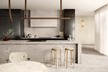
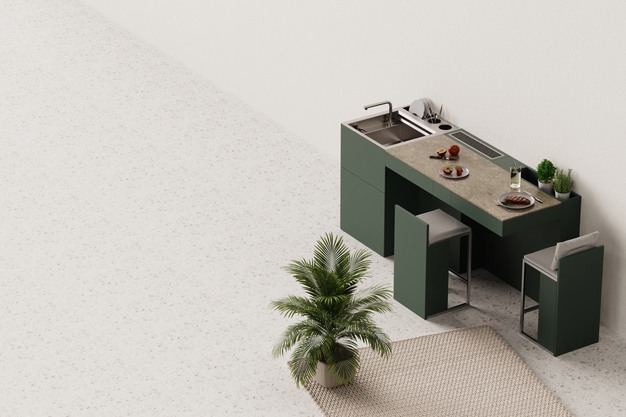
Inspired by a city layered through change, Smyrna approaches interiors as systems rather than fixed objects. Its flagship product, ALLinOne Kitchen, is a smart, modular, and circular kitchen system designed to evolve over time. Layer by layer, components can be upgraded, reconfigured, and reused instead of replaced, supported by digital infrastructure and UX-driven design.
By combining modular architecture, technology, and circular thinking, Smyrna creates adaptable interior systems that respond to changing lives putting long-term value, usability, and responsibility at the center of design.
 © Smyrna Design
For decades, kitchens have been treated as fixed installations, built once, used briefly, and discarded entirely when lifestyles, spaces, or trends change. Smyrna Design is challenging this logic at its core. Founded on the belief that circularity begins at the design stage, not with material choice alone, the company approaches the kitchen as an evolving system rather than a disposable product.
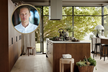
The idea for Smyrna's All-in-One Smart & Circular Kitchen was born from personal experience. Founder and Managing Director Pürlen Karaçam moved between several apartments in Berlin, each with different kitchen setups, some fully furnished, others completely empty. "I repeatedly found myself buying, selling, and wasting kitchens," she explains. "That's when I realized the problem wasn't the material, it was the system itself."
Conventional kitchens are designed according to a linear logic: fixed layouts, irreversible construction, and full replacement as the default response to change. This approach carries a heavy environmental cost. In Europe alone, around 11 million tonnes of furniture waste are generated each year, with kitchens accounting for roughly a quarter of that total. At the same time, emerging regulations such as Digital Product Passports and Ecodesign requirements are exposing how poorly traditional kitchen systems are prepared for traceability, reuse, and long-term accountability.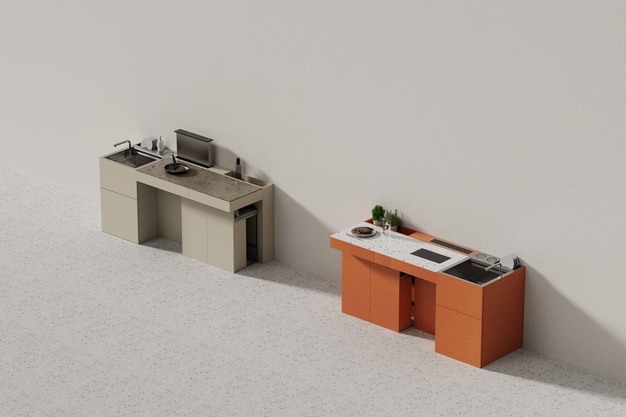 © Smyrna Design
Smyrna's response is a fully modular, freestanding kitchen system designed to adapt across homes, life phases, and even environments. "We don't design objects, we design systems," says Karaçam. "Every component can be detached, repaired, upgraded, or returned into circulation without starting from zero."
This system-based thinking defines what circularity means in practice for Smyrna. Beyond recyclable materials, circularity is embedded in how components are assembled, tracked, and maintained over time. Through take-back mechanisms and digital traceability, parts are designed to re-enter use cycles rather than becoming waste. "Circularity is an active relationship between the system and its users," Karaçam notes. "It's about extending value across multiple lifecycles, not just one owner."
Adaptability is another cornerstone of the design. As people move more frequently and living spaces become increasingly flexible, kitchens must respond accordingly. Smyrna's system is designed to transition seamlessly from indoor to outdoor use, treating the kitchen as adaptable infrastructure rather than a static installation. This flexibility allows the same system to be reconfigured for new homes, changing layouts, or semi-outdoor settings, without compromising performance or aesthetics.
Through strong collaborations between the public and private sectors, particularly within smart city initiatives and green construction projects for trending micro-apartments, this product has the potential not only to scale as a system solution, but to set a new benchmark for transforming the kitchen furniture industry's carbon footprint.
 © Smyrna Design
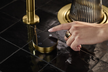
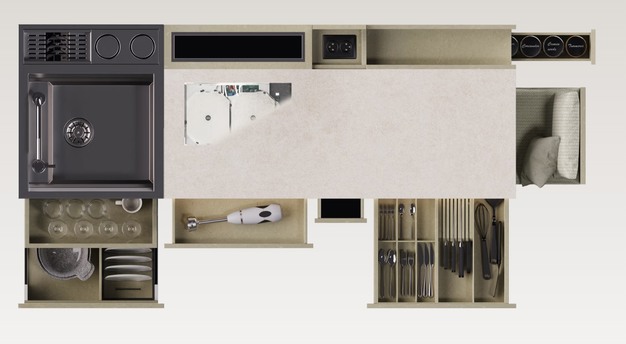
*The kitchen has an invisible induction alternative.
Industry standard
A key technical innovation lies in the use of lightweight aluminum foam, developed by ASAŞ in collaboration with the Fraunhofer IWU Institute. Originally intended for mobility and construction sectors, the 100% recycled and recyclable foundation material aluminium foam, offers exceptional strength with reduced weight. "The challenge was translating industrial performance into a human-centered furniture context," Karaçam explains. "But it allows us to combine durability, modularity, and full recyclability in one system."
Looking ahead, Smyrna is expanding its digital infrastructure through Digital Twins, enabling full lifecycle tracking, upgrades, and incentive-based take-back models. Beyond kitchens, the company sees strong potential in applying its system logic to compact living, floating houses, yachting, and other space-constrained environments.
"Our ambition is to help establish circular kitchen systems as an industry standard," says Karaçam. "Where long-term use, traceability, and measurable environmental impact are no longer exceptions, but the norm."
More information:
Smyrna Design GmbH
[email protected]
www.smyrna-design.de
Germany