

Founded in 1999 by Swedish designer Lina Rickardsson, Pappelina produces woven PVC and linen rugs at its local mill in Dalarna, Sweden. Combining traditional craftsmanship with modern design, the company's collections are distributed worldwide across residential and contract markets.
 © Pappelina
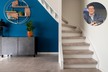
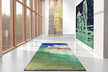
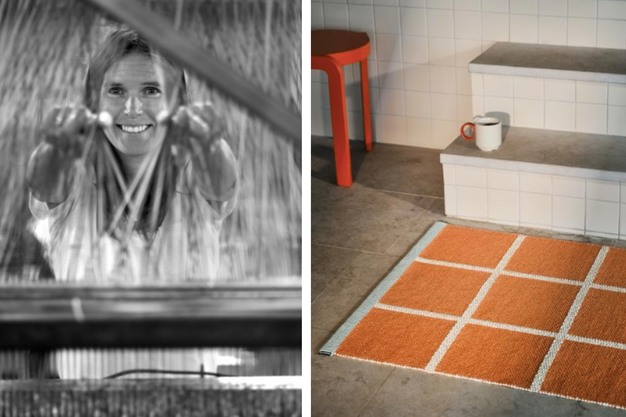
Lina Rickardsson, founder and creative director of Pappelina (left) and AW25-26 collection (right and featured below).
Lina Rickardsson, spoke to InteriorDaily about the evolution of the Swedish weaving house, its approach to materials, and the values that continue to shape the brand nearly three decades after its founding.
From tradition to transformation
Founded 26 years ago, Pappelina began as a revival of traditional plastic rug weaving, a Nordic craft once associated with affordability and utility. "We elevated it from being a simple, low-cost household item in the Swedish traditional home to becoming a quality design product now found all over the world," says Lina.
When she discovered the weaving mill in Leksand, Sweden, where artisans were using plastic ribbons, the idea of transforming a modest material into a design product took root. "I originally wanted to produce linen rugs," she explains, "but when I saw the plastic ribbons, I immediately recognised the potential to create something completely new."
Through experimentation, Pappelina developed its now-iconic jacquard weaving technique, which gave birth to designs such as VERA, a dotted motif that remains one of the brand's most recognisable pieces.
 © Pappelina
A collection built on playfulness and durability
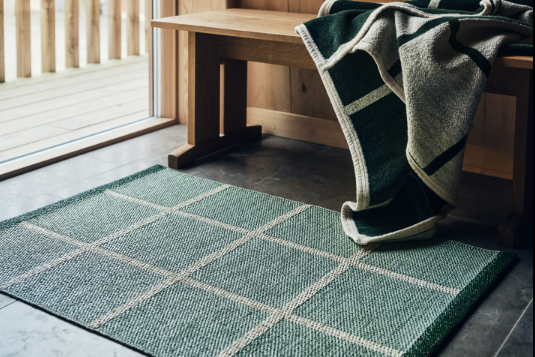
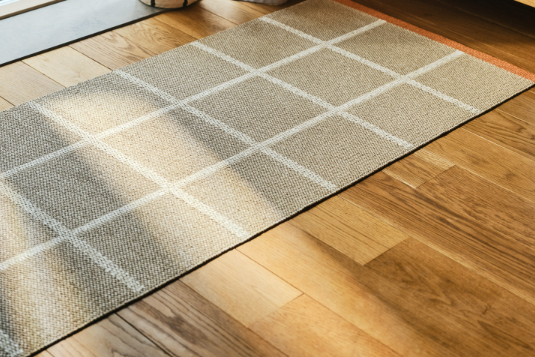
Pappelina's AW 2025 Collection continues the brand's exploration of pattern, material, and tactility. "Our design follows the idea of long-lasting design with a playful touch," says Lina. The new LEIF series draws inspiration from nature's autumn palette, while CRISS reinterprets the classic check, and CRISS POP brings a burst of colour for more expressive interiors.
Rather than following seasonal cycles, the collection remains anchored in Swedish craftsmanship and timeless appeal. "We don't work with key seasonal themes," she explains. "Our designs are created for a global audience, adaptable to styles across the world."
Sustainability through material intelligence
Sustainability and local production are central to Pappelina's identity. The introduction of BIOVYN™, a bio-attributed PVC derived from renewable sources, marks a further step toward responsible production. "Our plastic ribbons come from Gislaved in Sweden, meaning short transport distances and a smaller footprint," Lina notes.
Sweden's stringent sustainability standards support this approach, and Pappelina's model eliminates overproduction. "We weave locally, produce only what we sell, and have no excess stock," she adds. "Our rugs are made to last, in both design and material."
Weaving craftsmanship into scalability
Every Pappelina rug is made on traditional looms by skilled artisans. "Weaving takes time and skill, and skilled weavers are hard to find," Lina admits. "Kim, our production manager, represents the third generation at the weaving mill, and thanks to our long-standing expertise, we can pass this craft on."
Producing locally allows agility and control. "We weave what's needed and what our customers want," she explains. This model, balancing artisanal quality with flexibility, supports both domestic and international growth.
 © Pappelina
Heritage as a global language
Pappelina's identity is rooted in Swedish craftsmanship but expressed in a contemporary voice. "We have a solid, well-crafted product that's sustainable and defined by a classic design with a distinctive Pappelina edge," says Lina . This 'edge' comes through in form, colour, and proportion, details that have helped the brand maintain relevance across international markets.
While most growth currently comes from retailers and private clients, the brand's reach extends to hospitality and design professionals seeking durable, design-led rugs for contemporary interiors.
Materials, markets, and the road ahead
Despite global supply challenges and shifting trade policies, Pappelina's local production offers stability. "We are less exposed to disruptions because we source and produce in Sweden," Lina explains. "By maintaining our pricing, we never have to compromise, it allows us to uphold our vision and strategy."
Looking ahead, the brand continues to experiment with linen warps, integrating natural fibres into its weaves for greater depth and tactility. "Introducing linen reflects our desire to explore natural materials that complement our PVC base," she says.
 © Pappelina
Pappelina is also close to achieving zero seconds, a milestone reflecting minimal product waste, reinforcing the company's ongoing pursuit of efficiency and quality. "Made to last, in both material and expression" Lina concludes with a reflection that encapsulates Pappelina's ethos:
"We design rugs made to last, both in material and expression, with classic colours and patterns that stand the test of time. When you've created a product so distinct that people refer to it by your brand name, you hold on to that, and that's the vision we aim to carry forward."
More information:
Pappelina AB
Ryssnäsgatan 8
504 94 Borås,
+46 23-71 11 50
[email protected]
www.pappelina.com
Sweden