


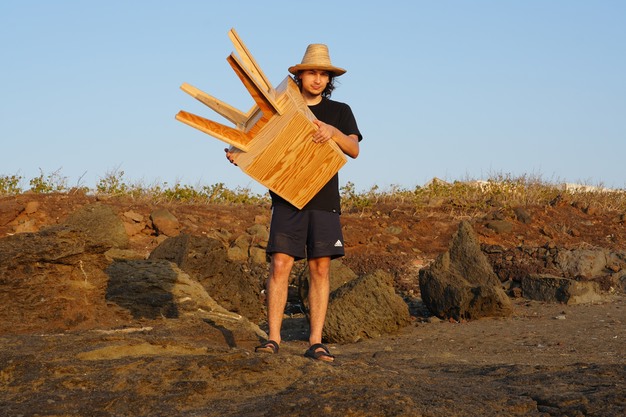
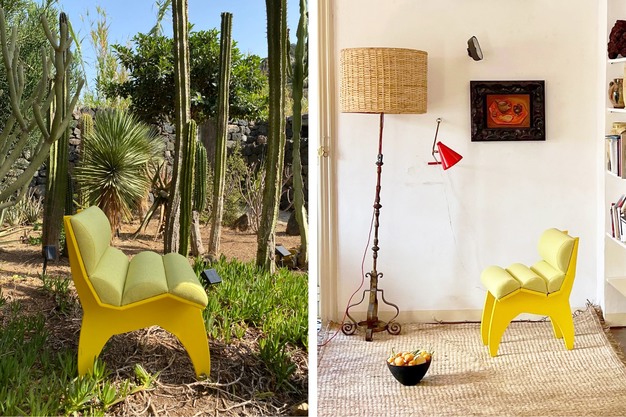
French-Italian designer Jules Régis, born in 1998 in Palermo and raised in Paris, studied architecture before returning to settle in his birthplace. His work engages with sculptural form, materiality, and intuition, drawing references from figures such as Jean Prouvé and Alexander Calder. The influence of Calder is explicit in the naming of his chair "Calder Yellow."
 © Jules Regis
Process and collaborations
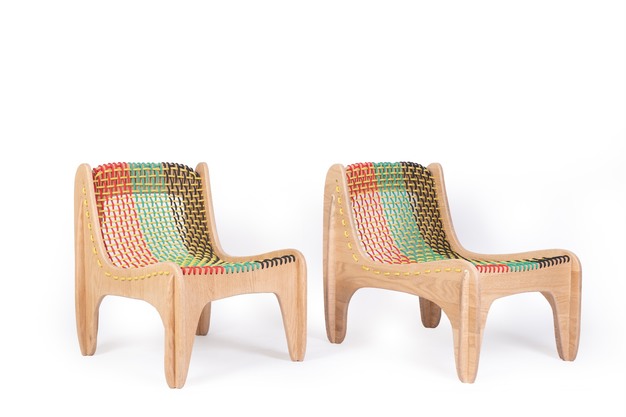
Régis describes his method as a balance between digital design tools and local craft knowledge. "I share my research with independent artisans such as the last tinsmith in Palermo or a family of chair caners," he notes, explaining how projects are tested in dialogue with makers across different trades.
He collaborates with carpenters, blacksmiths, upholsterers, and ceramicists in Palermo's working-class districts, situating his practice between virtual prototyping and semi-industrial or ancestral techniques. The result, according to Régis, is a gradual refinement of "forms and material assemblies" emerging through this exchange.
 © Jules Regis
Spider and spider.
Design approach
His practice emphasises silhouettes and proportions, often underlined by the use of colour. While his objects reference vintage aesthetics, Régis positions them within contemporary production frameworks. "Not taking oneself too seriously without lapsing into gimmickry, experimenting with freedom," he says, is the stance that informs his work.
This approach allows Régis to negotiate the interplay between design languages: digital precision and artisanal variation, sculptural research and functional outcomes.
 © Jules Regis
Calder Yellow Chair.
Outlook
With a focus on objects that engage both formally and socially, Régis proposes what he calls "an optimistic and resolutely contemporary art of living." The aspiration is to create pieces that enter daily use while retaining what he describes as a sense of "timeless familiarity."
For interior professionals, his trajectory illustrates a wider trend: young designers in Europe seeking to bridge virtual tools with heritage skills, producing work that resists strict classification between craft and industrial design.
 © Jules Regis
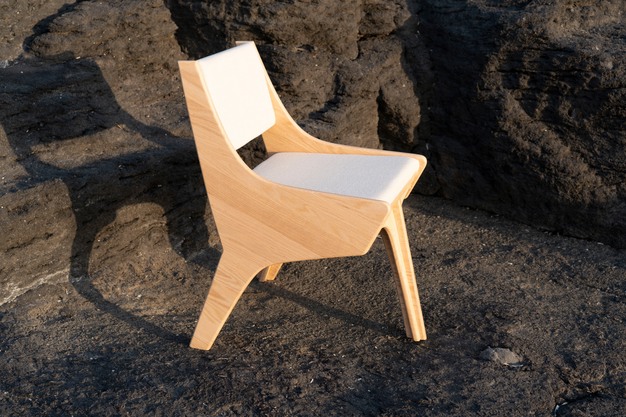
Falcone cream on rocks.
More information:
Jules Régis
Instagram
[email protected]
www.julesregisdesign.com