
GROHE is celebrating its 50th anniversary in the Netherlands this year with the "Already 50 years made for water pleasure" campaign. The originally German brand has developed into a global market leader since the introduction of the Skalatherm, the first thermostatic tap that made safe showering possible for households. As part of LIXIL, the brand leads the way in innovative water technology with tangible results: from market-leading brand awareness to water-saving showers that save up to 20,000 litres of water per year per person through GROHE Water Saving technology and smart design. The brand pillars of technology, quality, design and sustainability form the foundation for this: "Pure Freude an Wasser".
 © GROHE
Designed from the user's perspective
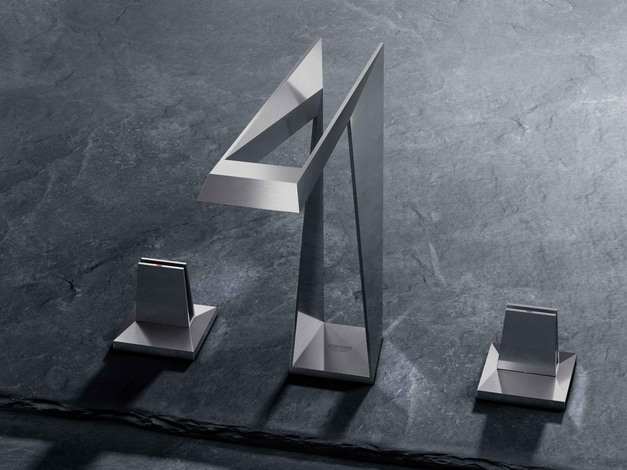
GROHE has been translating demands for comfort, safety and sustainability into innovation for decades. Skalatherm prevented scalding with constant water temperatures in 1956, as the world's first thermostatic faucet. The one-handle mixer (1968) allows both water flow and temperature to be controlled with one movement, while CoolTouch (2002) keeps the tap surface cool at all times. Recently, GROHE introduced the Icon 3D (2019), which offers maximum design freedom with minimal use of materials.
Christian Götter, Leader Northern Europe & General Manager GROHE Netherlands: 'All our innovations have always focused on one question: what does the user really need? To keep answering this, you have to look ahead as a company. In 2025, that means responding to trends such as personalisation, self-care and sustainability, themes that are an important part of what consumers want when it comes to bathroom design.'
 © GROHE
Quality & design: one promise
According to GROHE, quality is a basic need of every consumer, and therefore the starting point of every product design. To actually guarantee that quality, all products are subjected to extreme tests before being produced for consumers; for example, a thermostatic faucet endures 50,000 temperature changes in a fortnight in the laboratory, the equivalent of ten years of intensive use. Besides quality and technology, design also plays an essential role in turning everyday interactions with water into moments of pleasure.
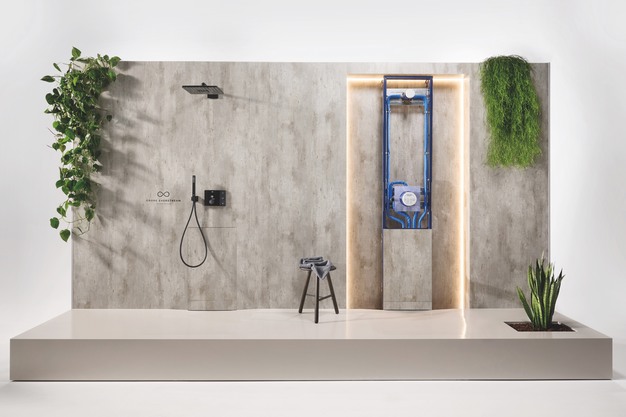
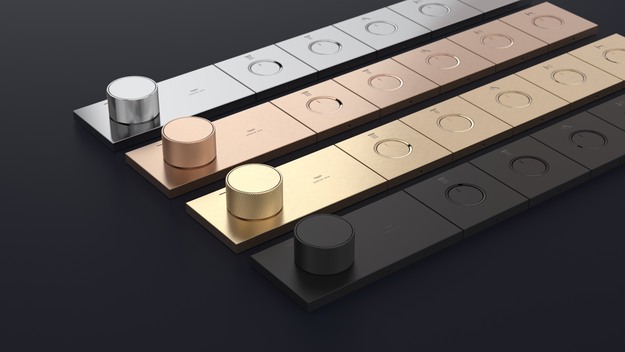
'Nowadays, the bathroom is no longer just a practical room, for many it is a relaxing oasis that they want to personalise down to the last detail: from shape and colour to functions. Our design philosophy reflects this, combining a distinctive signature style with aesthetics and ease of use,' says Patrick Speck, Leader, LIXIL Global Design, LIXIL EMENA. Take for example the GROHE Grohtherm Aqua Tiles, they embody the essence of a personalised experience. Users can create their ideal shower arrangement and even customise the SmartControl thermostat with interchangeable cover plates. With the ability to add modular ceiling showers, additional body sprays or head and hand showers, the shower system shows how far personalisation can go to create a truly individual wellness moment.
 © GROHE
2030: Investing in the future of water and craftsmanship
Water scarcity is looming in more and more places, including the Netherlands, but GROHE research shows that consumers often underestimate this risk. That is why the company invests not only in products with technology that saves water, such as the GROHE Tempesta 110 hand shower (up to 50% less water consumption, good for up to 20,000 litres per year) and the Everstream water recycling shower (up to 65% cost savings and 70% less CO₂*), but also in raising awareness through initiatives such as GROHE Team Ocean. To raise water awareness, the team rowed across the Pacific Ocean with less than 8 litres of water per person per day, while the average water consumption in the Netherlands is 129 litres.
Even in its own production and business operations, GROHE focuses on the next 50 years, and therefore deals smartly with water, energy, and resource use. In 2007, GROHE began measuring its own carbon footprint and since then has made drastic changes. For example, gas consumption at key production sites has been reduced by 20%, and the company saves 37 million plastic items a year by eliminating unnecessary plastic packaging.
There is also a growing shortage of installers, which puts pressure on both operations and user experience. Christian Götter, Leader Northern Europe & General Manager GROHE Netherlands, emphasises, 'For a future-proof business, we are investing in the future of water and the field. This is why we are actively working on solutions to the shortage of professionals over the next five years.' Specifically, this means increasing the knowledge of installers through GROHE product training programmes and various services that add value by saving time and money.
More information:
GROHE
www.grohe.nl