


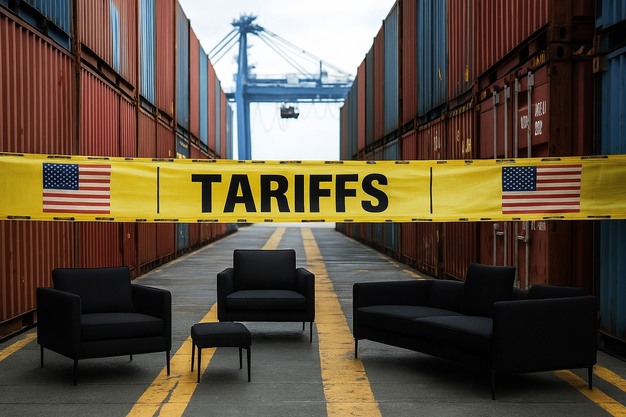
Yesterday, this news site reported that on Friday, August 22, Trump announced plans to impose import tariffs on furniture. A 50-day investigation has been launched, and he stated that furniture entering the United States will be subject to a yet-to-be-determined tariff. The president described this move as an effort to bring the furniture industry back to key manufacturing states, like North Carolina, South Carolina and Michigan.
This development is once again shaking up European and indeed global trade. What are various countries saying about this?
 © Marie-Elise Bruins Slot | InteriorDaily.com
Poland has also responded with concern to the decision, which is mainly intended to support American manufacturers but could have consequences for Polish exports, which are growing in the U.S. market. Poland-Furniture.com notes that the U.S. is one of the most important export markets for Polish manufacturers. According to the website, Poland's furniture exports to the United States reached approximately 2 billion PLN in 2023, an increase of 18% compared to the previous year. Forecasts for 2024 projected a further growth of 10–12%.
The Dutch Royal CBM announced that it will raise the issue at the European level through EFIC (European Furniture Industries Confederation), after which a joint response from the European furniture industry will follow.
The German economy is also affected by Trump's tariffs: 'This hits the core of our exports'. The possible reintroduction of import tariffs by the Trump administration in the United States has led to concerned reactions from politics, industry, and the economy in Germany. Although a full-scale trade war has been averted for now, German leaders warn that the planned levies will be a heavy burden for the country's export-oriented economy.
Politics calls the agreement unsatisfactory. The Federation of German Industries (BDI) calls the agreement a "fatal signal" and warns that a 15% tariff would have a significant negative impact on German industry. The BDI states that the EU needs a clear strategy to protect the competitiveness and resilience of its economy. The German automotive industry, represented by the VDA, also fears the additional burden the tariffs will impose, especially as the sector is currently undergoing an expensive transformation.
Spain's trade with the United States has been under pressure due to previous tariffs. For instance, in the first half of 2025, Spanish exports to the U.S. declined by 5.1%, contributing to a 37% increase in the bilateral trade deficit, which reached €7.08 billion . Additionally, the European Union has already agreed to a 15% tariff on most European imports to the U.S., including furniture, as part of a broader trade agreement aimed at avoiding a full-scale trade war. Given this context, Spain is likely to be affected by any new U.S. tariffs on furniture imports. The Spanish government, along with EU institutions, may need to assess the potential impact on Spanish exporters and consider appropriate responses to mitigate any adverse effects on the Spanish economy.
Italy is the second largest exporter of furniture to the US, after China, and the American market accounts for approximately 10% of Italian furniture exports. In response to previous US import tariffs, the Italian government has taken measures to reduce the impact on businesses. For example, temporary import duties were suspended on 89 products, including furniture, which is expected to save Italian companies around €17 million annually. Additionally, the financing capacity of Italian export credit insurers was increased to support exporters.
Tariffs will hit the UK hard too, as the US is a key export market. Just last year, British manufacturers exported £2.2 billion worth of goods across the Atlantic.
So what could the import tariffs mean for UK furniture makers?
Rising costs: Even if your finished furniture isn't directly hit with the 25% import duty, raw materials like steel and aluminium are. That means higher production costs, which will eventually be passed on to the final price.
Supply chain challenges: Many UK furniture makers use components sourced from around the world, including China – which faces its own US import duties. Expect increased bureaucracy around rules of origin.
Competitiveness at risk: If US retailers can source similar products at lower prices from countries not facing tariffs, what's stopping them?
Market Concerns
The announcement had immediate effects on the stock market: shares of major furniture importers, including Wayfair, RH, Arhaus and Williams-Sonoma, fell. Companies like La-Z-Boy, Ethan Allen Interiors and Steelcase which produce furniture in the U.S., have already seen a rise in their stock prices since the announcement. Manufacturers and importers are also expressing concerns. Companies such as Lexington Home Brands and Universal Furniture have already had to implement price increases and surcharges to offset previous tariff hikes. Some companies temporarily absorbed the increased costs but warn that this is unsustainable in the long term.
Several industry associations have previously spoken out against new import tariffs. They argue that there is no direct link between furniture and national security and fear that additional tariffs may further harm the remaining American manufacturing by raising the prices of raw materials.
However, reshoring also presents challenges. The American furniture sector is heavily dependent on global supply chains for raw materials and components. Tariffs could raise production costs for domestic manufacturers that source parts abroad, potentially offsetting the benefits of reduced foreign competition. Furthermore, a slowing U.S. housing market and inflation-driven consumer caution may limit demand for new furniture, even if domestic producers gain a pricing advantage.
In terms of container export volume, furniture is one of the largest product categories in the Chinese and U.S. ocean freight market, according to logistics expert Marky Zheng. 'Trump has not specified which tariffs might be imposed after the investigation,' he says, 'but based on previous tariffs on steel and aluminum, industry experts predict that if Trump ultimately acts to protect the domestic furniture industry, furniture imported from around the world could face tariffs of 25% or even 50%.'
The final outcome is expected to be announced by October 11.
Would you also like to share, in a (free) article, how these import tariffs will impact your business? Let us know, and we'll publish a great article about it!
Sources: AInvest, Moneypl, Onvista, Elpais, SCMP, RetailRevealed, SeekingAlpha