

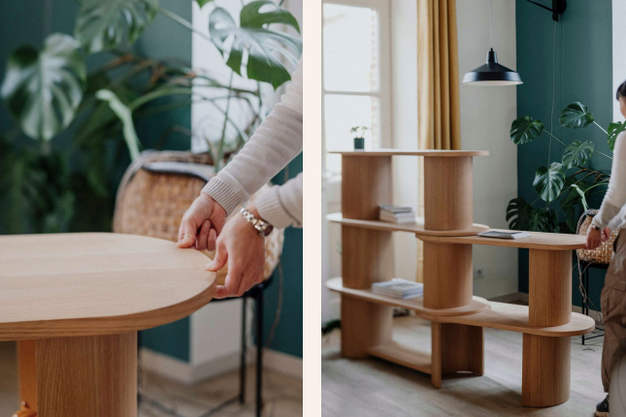
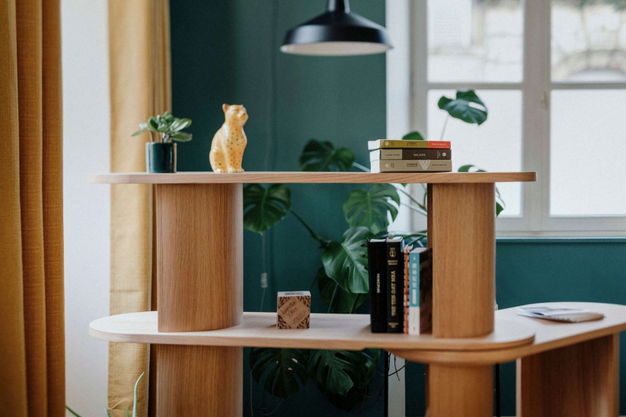
Hévéa House has introduced Charlotte Bibliothèque, a modular bookcase inspired by Charlotte Perriand's early 20th-century U-shaped storage systems. Perriand's original work combined wood and tubular metal to define modern furniture forms. The contemporary reinterpretation replaces sharp angles with curves. 'This creates a cornerless environment that feels safer and more harmonious,' according to Hévéa House.
A central feature of the piece is a rotatable wooden mechanism developed by Hévéa House Design, allowing the bookcase to pivot approximately 95 degrees. This functionality enables users to adapt the unit to different spatial configurations while retaining structural stability.
 © Hévéa House
Material choices and sustainability
Sustainable timber is a key element in Charlotte Bibliothèque. The design employs FSC-certified veneered oak and rubberwood for the rotating system. Hévéa House explains that, by developing a wooden rotating system, we reduce reliance on metals while emphasising recyclability and eco-friendliness.' The choice of materials supports a lightweight, manageable structure while aligning with circular design principles increasingly relevant to the interiors sector.
Urban adaptability
The Charlotte Bibliothèque addresses the constraints of compact urban living. The modular design allows for multiple configurations: against a wall as a traditional bookcase, as a semi-open partition, or with its lower section serving as a multifunctional corner. This corner can accommodate pets, a small stool, or additional storage, reflecting the piece's adaptability to varied user needs. Hévéa House notes that 'urban living often means compact spaces, so adaptability is essential,' highlighting how multifunctionality is embedded in both design and usage.
Development process and engineering
Hévéa House outlined a staged development process. Initial concepts drew on Perriand's philosophy, balancing natural aesthetics with functional requirements. Prototype testing focused on wooden rotating disks to ensure durability and precision in the pivot mechanism. Final production was realised with the expertise of RK Resources, a manufacturing partner experienced in translating concept to industrial execution.
Engineering challenges primarily involved reconciling the demands of a rotatable system with the visual language of wood. 'The rotating system required high stability, but we didn't want the design to appear too technical or heavy,' explained Hévéa House. The solution integrates careful woodworking and material selection to achieve stability without compromising the intended aesthetic.
 © Hévéa House
Philosophy and presence
Charlotte Bibliothèque embodies a philosophy of presence and material awareness. Hévéa House describes the piece as an invitation to reconnect with physical space: 'It calls us back to the real touch of materials: the smoothness of wood, the flow of arcs, the grounding sensation of tactile connection.' The design also emphasises relational space, accommodating pets alongside users, or flexible storage to support daily routines.
Debut at Maison & Objet
Hévéa House will present Charlotte Bibliothèque at Maison & Objet, marking the company's first participation. The fair provides a platform for presenting both the design concept and production capabilities. Alongside Charlotte Bibliothèque, the brand will exhibit five new designs under the theme "tropical inspiration meets contemporary craftsmanship," reflecting sustainable materials, innovative mechanisms, and human-centred functionality.
Hévéa House frames this debut as more than a product presentation: it is an opportunity to communicate a design philosophy that integrates modularity, sustainability, and spatial adaptability, aligning with trends in European interiors where multifunctional and material-conscious furniture is increasingly in demand.
More information:
SARL Hévéa House
[email protected]
www.heveahouse.fr
France